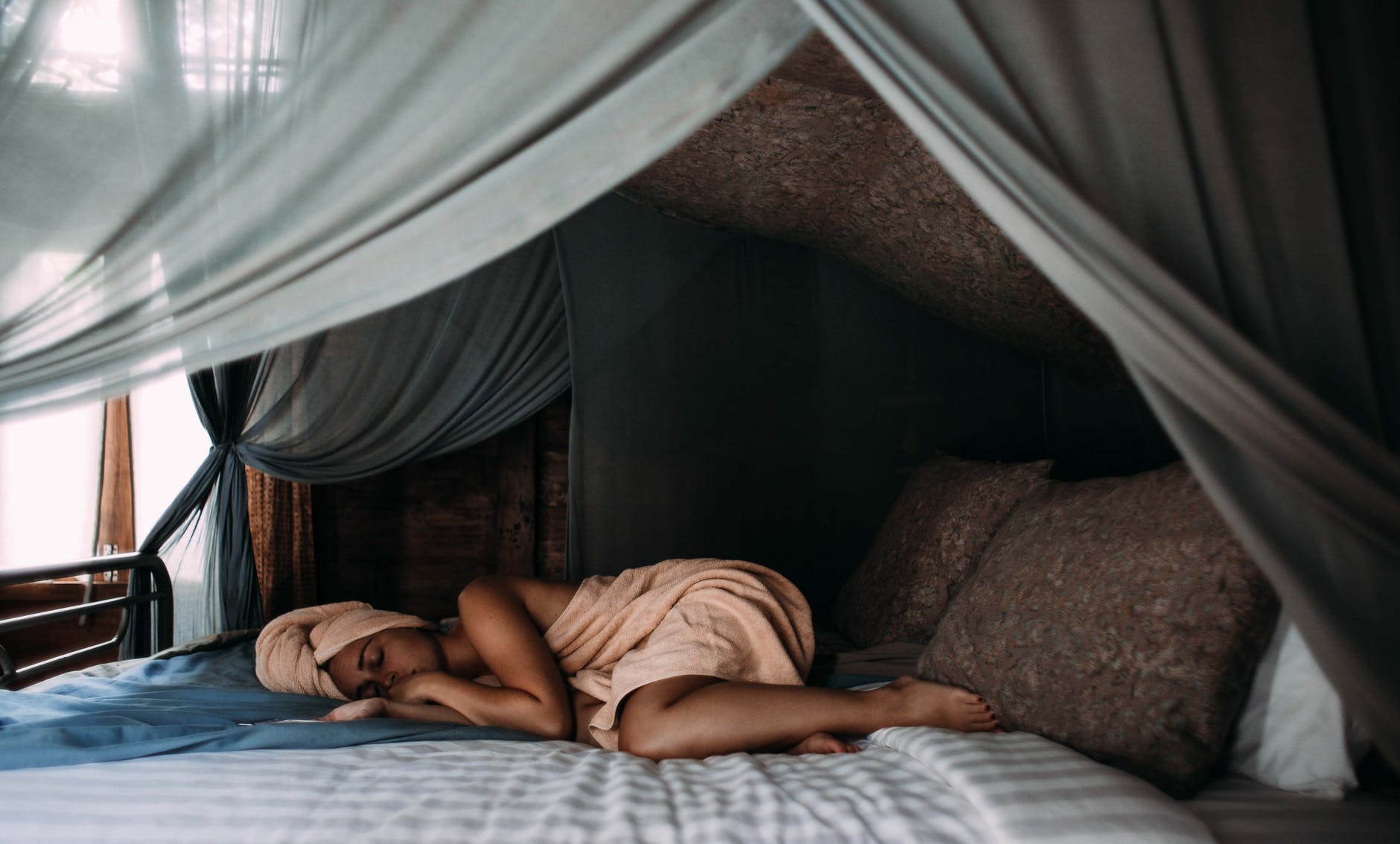
How did you sleep last night? Do you feel like you’re getting enough sleep? Chances are, if you’re reading this article, you aren’t! The National Sleep Foundation recommends 7-9 hours for adults (1). But you are not alone! According to the Sleep Foundation 32.6% of working adults slept for six or fewer hours per night, between 2017-18 (2).
The good news is there are things you can do to help improve your sleep, even if it’s just improving the quality of the sleep you do get.
When we sleep we cycle through various stages of sleep and these fall into two categories; rapid-eye-movement (REM) sleep and non-rapid eye movement (NREM) sleep, which has 3 stages. We cycle through these stages about 4-6 times, each stage lasting, on average, 90 minutes (3).
Our circadian rhythm, our internal clock that controls many internal systems, regulates our sleep/wake cycles. Our needs change over the course of our lives, from spending 50% of our time asleep as a newborn to needing 7-9 hours as an adult (3).
Depending on your chronotype, whether you’re a night owl or lark, you may experience social jetlag (4). If you are a night owl you might struggle to get up when your alarm goes off in the week and then sleep in at weekends, if this is you, you are experiencing social jetlag. There is a mismatch between work and social obligations and your internal clock, your circadian rhythm. It is not just about getting the right amount of sleep but also the timing and regularity of it (4).
Increased variability in sleep timing has been linked to obesity (5), lower lean mass (6) and increased cardiovascular disease risk (7) (8).
Alarm clock use has led to shorter sleep, self-reported sleep records suggest that worldwide sleep duration has fallen by approximately 3.7 minutes per year in the last decade (5). This is strongly associated with the increase in chronic diseases, such as type 2 diabetes (9).
So what are the top tips to improve your sleep? Lets take a look (10) (11):
During the day:
- Get outside in morning, this will help reset your internal circadian rhythm clock
- Avoid excess consumption of caffeine in the afternoon/evening
- Exercise, but not too close to bedtime (more than 2 hours before bed)
- Have your last meal at least 3 hours before bed
Before bed:
- Create a routine, go to bed and get up at roughly the same time everyday
- Relax before bed, this could be taking a bath, reading, listening to music, whatever relaxes you
- Dim bright lights 30 mins to an hour before bed
- Stay off your phone, tablet, computer from an hour before bed
- Keep it quiet, or use apps such as headspace or calm to create ‘white noise’
Take it one step at a time and try adding the ones that appeal to you first, then track your sleep and watch for improvements.
Comment with any changes you’ve seen 🙂
References:
- Hirschkowitz, M., Whiton, K., Albert, S.M., Alessi, C., Bruni, O., DonCarlos, L….& Hillard, P.J.A. (2015). National Sleep Foundation’s sleep time duration recommendations: methodology and results summary. Sleep Health, 1(1), 40-43. [accessed April 2022 via https://doi.org/10.1016/j.sleh.2014.12.010].
- Sleep Foundation. (2022). Sleep Statistics. [Accessed April 2022 via https://www.sleepfoundation.org/how-sleep-works/sleep-facts-statistics].
- Patel, A.K., Reddy, & V., Araujo. (2021). Physiology, Sleep Stages. [Accessed via https://www.ncbi.nlm.nih.gov/books/NBK526132/].
- Geddes, L. (2019). Social jetlag – are late nights and chaotic sleep patterns making you ill? The Guardian. [Accessed April 2022 via https://www.theguardian.com/lifeandstyle/2019/jan/21/social-jetlag-are-late-nights-and-chaotic-sleep-patterns-making-you-ill].
- Roenneberg, T., Allebrandt K.V., Merrow, M. & Vetter, C. (2012). Social jetlag and obesity. Curr Biol, 22(10), 939-943. [Accessed April 22 via https://pubmed.ncbi.nlm.nih.gov/22578422/].
- Kim, M., Sasai, H., Kojima, N. & Kim, H. (2015). Objectively measured night-to-night sleep variations are associated with body composition in very elderly women. J Sleep Res, 24(6), 639-647. [Accessed April 22 via https://pubmed.ncbi.nlm.nih.gov/26250860/].
- Wong, P.M., Hasler, B.P., Kamarck, T.W., Muldoon, M.F. & Manuck, S.B. (2015). Social Jetlag, Chronotype, and Cardiometabolic Risk. J Clin Endocrinol Metab, 100(12), 4612-20. [Accessed April 22 via https://pubmed.ncbi.nlm.nih.gov/26580236/].
- Taylor, B.J., Matthews, K.A., Hasler, B.P., Roecklein, K.A., Kline, C.E, Buysse, D.J….& Hall, M.H. (2016). Bedtime Variability and Metabolic Health in Midlife Women: The SWAN Sleep Study. Sleep, 39(2), 457-65. [Accessed April 22 via https://pubmed.ncbi.nlm.nih.gov/27091639/].
- Potter, G.D.M., Skene, D.J., Arendt, J., Cade, J.E., Grant, P.J. & Hardie, L.J. (2016). Circadian Rhythm and Sleep Disruption: Causes, Metabolic Consequences, and Countermeasures. Endocr Rev, 37(6), 584-608. [Accessed via https://www.ncbi.nlm.nih.gov/pmc/articles/PMC5142605/].
- MedicinePlus. (2022).Healthy Sleep. [Accessed April 22 via https://medlineplus.gov/healthysleep.html].
- Foster, R.G. (2020). Sleep, circadian rhythms and health. Interface focus, 10. [Accessed April 22 via http://dx.doi.org/10.1098/rsfs.2019.0098].
 HPS.Healthandnutrition